

Meta dropped $900 million on CRED. Kunal Shah is now running WhatsApp. Everyone’s calling it a masterstroke. I’m not sure anyone has actually looked at the math.
I wasn’t going to write about this.
I really wasn’t. I had things to do. I was going to spend this Tuesday finishing a different piece, maybe touching grass, maybe rewatching The Godfather for the fifth time and convincing myself I’d spot something new in the Baptism Massacre scene. But then I woke up, opened my phone like the dopamine-dependent creature I am, and the timeline was absolutely losing its mind.
Meta. CRED. $900 million. Kunal Shah running WhatsApp.
The business press called it “a masterstroke.” Twitter has crowned Kunal the next tech genius. Even my Dad WhatsApped me the updated list of Indian CEOs.
But, Don Corleone once said that a man who doesn’t spend time with his family can never be a real man. Kunal Shah just left his family’s business to go run someone else’s. Make of that what you will.
Okay, But First: What Even Is CRED?
CRED’s model is straightforward once you see it.
India has roughly 50 million people with a CIBIL score above 750. CIBIL is India’s primary credit scoring system, think of it as a financial report card that tracks how reliably you’ve repaid loans and credit card bills over your lifetime, scored between 300 and 900. Above 750 means you’ve been disciplined: no missed EMIs, no defaults, no funny business. Banks love these people. They’re low default risk, high income, and they actually pay back what they borrow. The problem is finding them efficiently. CRED solved that by building the world’s most expensive credit score filter: a members-only app that only lets you in if your score qualifies.
The entry ticket is paying your credit card bills through the app. Do that, get rewarded, coins, cashback, airport lounges, exclusive offers. The rewards keep you engaged. The engagement keeps you on the platform. And the platform now knows exactly who you are, what you earn, and how reliably you pay your debts.
That data is the product. CRED partners with banks and NBFCs to offer personal loans, credit lines, and other financial products to its members. Since CRED has detailed financial data on users, credit scores, payment behaviour, spending patterns, it can assess creditworthiness accurately. When users take loans through CRED, the company earns referral fees or revenue sharing from lending partners. The lender gets a pre-verified, low-risk borrower. The member gets a loan with minimal friction. CRED takes a cut in the middle.
But lending is only one stream. CRED charges a processing fee of around 1 to 1.5% on various transactions, including payments made through CRED Pay and its rent payment feature. It has few other ways to earn money by capitalising on high credibility user base
The catch is what it costs to build that user base. CRED spent years running some of the most expensive marketing campaigns in Indian startup history, IPL slots, celebrity ads, cultural moments, to convince a small, high-value audience to trust it with their financial data.
Let’s look at the Numbers
For most of its existence, CRED has spent significantly more money than it has generated. That’s not an accusation, it’s structurally what early-stage consumer fintech looks like when you’re building trust at scale before monetising it. But the numbers are worth looking at clearly, because the narrative around this deal has been suspiciously celebratory.
Here’s the actual trajectory:
In FY22, CRED generated ₹394 crore in revenue and lost ₹1,280 crore. It was spending roughly ₹3 on marketing, operations, and infrastructure for every ₹1 it earned. FY23 and FY24 looked similar, revenue grew, but so did absolute expenditure. The losses weren’t narrowing in any dramatic way. The machine was getting bigger and staying expensive.
FY25 is where things genuinely started to shift. Operating revenue reached ₹2,735 crore, up 16% year-on-year. More importantly, operating losses narrowed 51% to ₹298 crore, meaning the core business, stripped of accounting adjustments, was almost breaking even. Gross margins held at 70%, which is high for fintech and reflects the fact that CRED’s revenue is increasingly coming from high-margin lending commissions and brand partnerships rather than low-margin transaction processing.
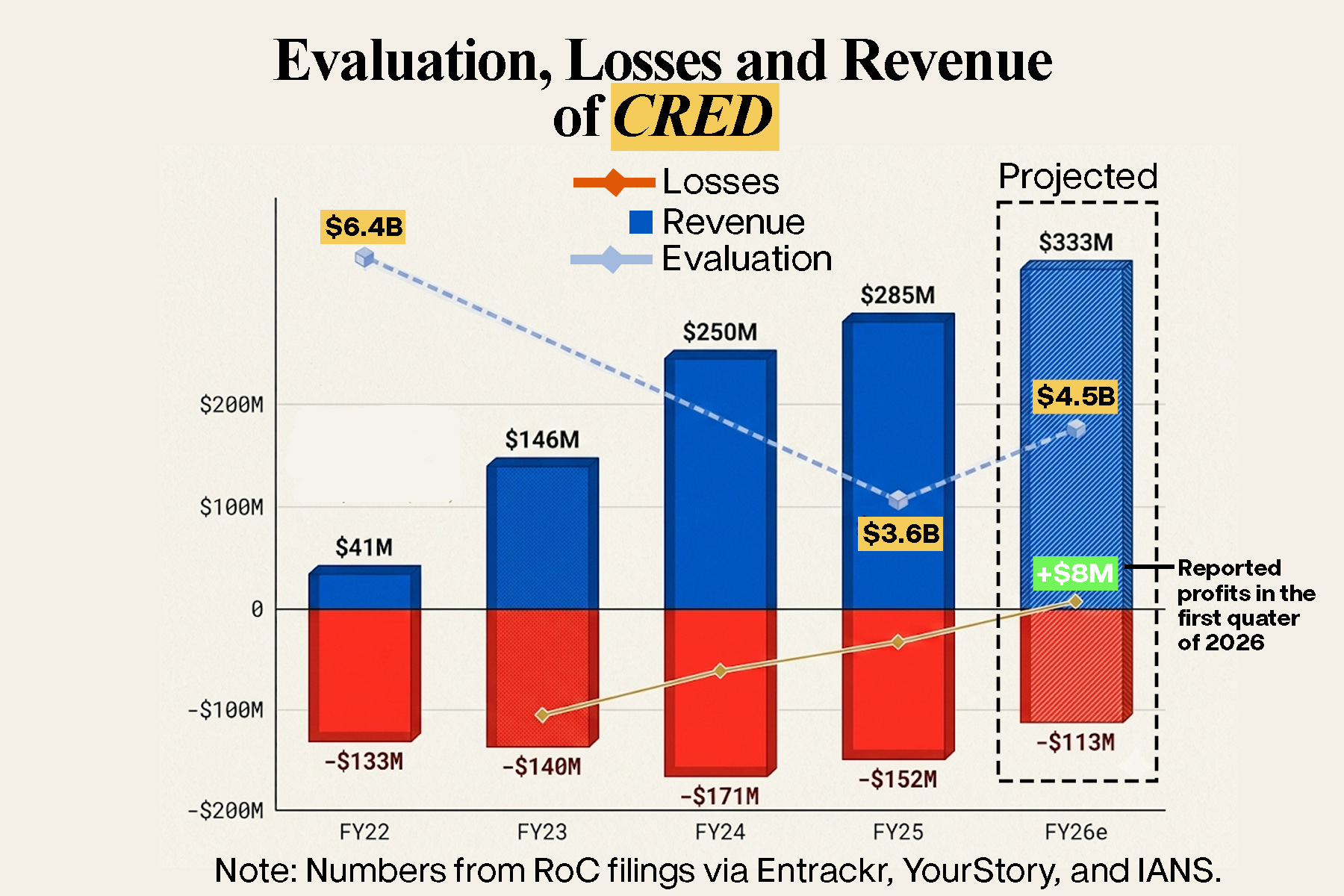
The total net loss figure, ₹1,457 crore in FY25, is larger than the operating loss because it includes ESOPs, depreciation, and other non-cash items that don’t affect day-to-day operations but do show up on the P&L. This distinction matters. The operating loss tells you whether the business works. The net loss tells you the full cost of building it. Both numbers are real. Only one of them is the one startups like to talk about.
CRED says it hit its first profitable quarter in early FY26, and is targeting full operating profitability for the full year. That’s credible given the trajectory, but worth holding lightly. “First profitable quarter” has preceded a lot of premature IPO excitement in Indian startup history.
Then there’s the valuation history, which is the most important context for this deal and somehow the least discussed.
CRED peaked at $6.4 billion in 2022. That was the global peak of easy money, low interest rates, abundant VC capital, and a funding environment where growth metrics mattered more than unit economics. Then the macro shifted. Post-2022, central banks globally hiked rates aggressively. Capital became expensive. VCs, who had been writing cheques liberally through 2020 and 2021, became significantly more disciplined. Dozens of Indian startups took down rounds in this period like Byju’s, Swiggy, Ola Electric, as independent investors re-priced risk without the optimism of a zero-rate world. CRED was not exempt. In May 2025, it raised $72 million from GIC at a valuation of $3.64 billion. Almost half its peak, in one round.
This wasn’t a CRED-specific failure. It was a market correction applied to a company that had been priced for perfection in 2022 and was now being priced for reality in 2025. The down round reflects where institutional investors, people with no strategic stake in the outcome, thought CRED was headed when they had to write an actual cheque.
One year later, Meta comes in at $4.5 billion and the ecosystem exhales like the down round never happened. But it did happen. A $900 million strategic cheque from one of the most valuable companies on earth doesn’t erase that signal. It introduces a different kind of signal, one with its own motivations, its own synergies, its own reasons to pay a premium that have nothing to do with CRED’s standalone value.
The business is improving. The trajectory is real. But we’re at “finally not bleeding,” not “always was inevitable.” There’s a difference, and it matters for how you read everything that follow
Meanwhile, WhatsApp Pay Has Been Sitting on the Biggest Fumble in Indian Tech
Let’s talk about WhatsApp Pay. Because this is really what the deal is about, and the story is significantly more embarrassing for Meta than anyone wants to admit.
WhatsApp has over 500 million users in India. Five hundred million. That is not a market, that is a continent. And WhatsApp Pay, despite receiving regulatory clearance to operate fully across its entire India user base in December 2024, currently holds approximately 0.65% of UPI market share.
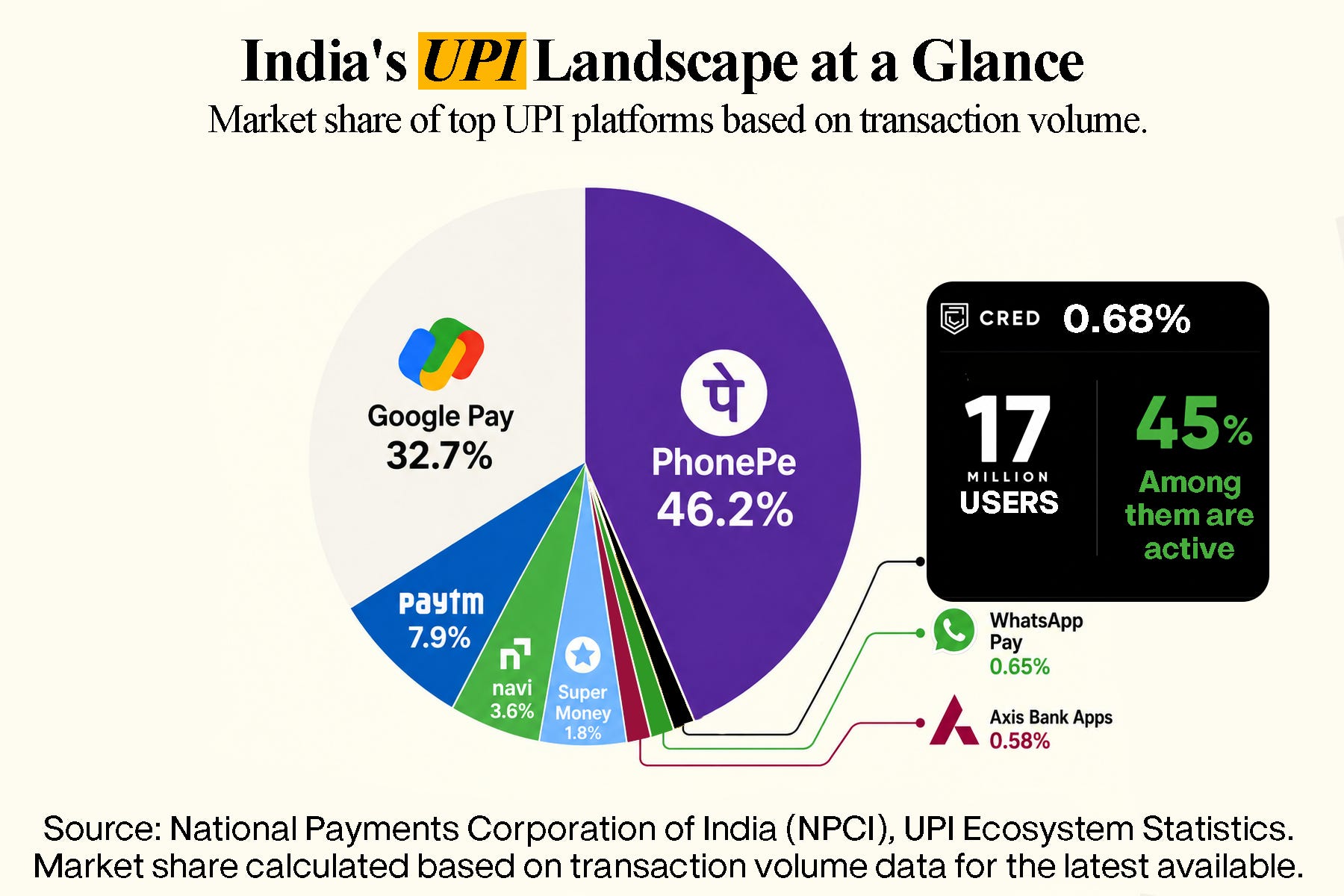
Source: National Payments Corporation of India (NPCI), UPI Ecosystem Statistics. Market share calculated based on transaction volume data for the latest available.
PhonePe and Google Pay between them hold nearly 80% of the market. They got there by being early, by being fast, by building habits in a population that was suddenly, thanks to demonetisation and Jio, using smartphones for money for the first time. WhatsApp spent years fighting NPCI and the RBI over interoperability and user caps while the other players compounded. By the time Meta could play freely, the game was essentially over.
You might say: WhatsApp has 500 million users, surely they can still come back. And you’d be right that the distribution is there. But distribution isn’t the problem. The problem is habit. When an Indian wants to pay for something on UPI, their thumb goes to PhonePe automatically. That’s not a product problem. That’s a psychological problem. And psychology at scale is one of the hardest things in tech to change.
The Deal: What Actually Just Happened
Meta invested $900 million for a roughly 20% stake in CRED at a $4.5 billion post-money valuation, a mix of primary and secondary shares, no board seat for Meta, no customer data sharing, CRED stays structurally independent. Miten Sampat, CRED’s head of strategy and finance since 2020, becomes interim CEO and Kunal Shah goes to become Global Head of WhatsApp, replacing Will Cathcart who led the platform for seven years.
This is the part where every business journalist used the phrase “an offer he couldn’t refuse.”
They’re not wrong. But I want to sit with that phrase for a second, because in The Godfather, that line doesn’t actually describe a good deal. It describes a coerced one. The Hollywood producer woke up with a horse’s head in his bed. He wasn’t thrilled. He complied because the alternative was worse.
So let’s be honest about the geometry of this deal, because the structure tells you more than the press release does.
Kunal Shah is leaving CRED, and that is the central fact everything else is built around. A founder leaving his company, especially one whose entire brand identity is inseparable from his personality, is not a neutral event. It raises questions, spooks employees, and complicates the IPO story. And CRED, remember, just came off a down round twelve months ago. It needed its next chapter to look like momentum, not abandonment.
The $900 million is, at least partially, the answer to that problem.
If Shah had simply taken the WhatsApp job and walked away, CRED would be heading into its IPO window as a founder-less company last valued at $3.64 billion in a down round, with an interim CEO nobody outside the company has heard of. That is not a great story to tell public market investors. But if Shah leaves and simultaneously Meta writes a $900 million cheque that resets the valuation to $4.5 billion, now the story is different. Now CRED is “the company Meta backed right before its IPO.” Now the down round is a footnote, not the headline.
The investment isn’t just capital. It’s a valuation reset, a credibility transfer, the thing that makes Shah’s departure look like an elevation rather than an exit. And it protects Shah too, because walking away from your own company into a competitor’s orbit looks very different when you’ve just brought in $900 million on the way out the door.
Whether that framing holds up under scrutiny is a different question entirely. The $4.5 billion valuation is being set by a strategic investor with its own reasons to pay a premium, access to Shah’s expertise, a minority stake in India’s most premium fintech, an ecosystem relationship ahead of WhatsApp’s commerce push. That is not the same as an independent investor looking at CRED’s standalone fundamentals and concluding it’s worth $4.5 billion on its own merits. The number is real but the signal it sends is not independent of who wrote the cheque.
CRED is now heading toward an IPO with fresh capital, a famous minority shareholder, and a recovered valuation. Those are genuinely good things. But it’s also heading there without its founder, with an interim CEO, and with public market investors who will eventually look past the Meta logo and ask what the business is actually worth on its own terms.
The Corleones always made their deals look mutually beneficial. That was the genius of it. Whether this one actually is, for CRED’s future shareholders, is the question nobody is asking loudly enough right now.
What Meta Is Actually Betting On (And Why It’s Not Obvious)
Meta Chief Product Officer Chris Cox said they were looking for someone with “an intuitive grasp” of WhatsApp’s global product opportunity, who could “navigate the disruption expected from artificial intelligence” and lead the world’s largest communication platform. “Kunal became the clear choice,” he said.
Okay. But let’s interrogate this a bit.
WhatsApp’s stated ambition is the super-app dream: discovery on Instagram, conversation on WhatsApp, purchase inside WhatsApp, payment done, no app switching, no friction. It works beautifully in theory. In China, WeChat did exactly this and became an operating system for daily life. In India, it hasn’t happened for WhatsApp despite years of trying, and the reason is straightforward. India already has a fragmented but functional answer to every piece of that stack. Reels for discovery, WhatsApp for messaging sure, but Meesho and Flipkart for commerce, PhonePe for payments, and literally thirty apps for financial services. The super-app dream assumes users are waiting for integration. Indian users built their own integration, app by app, over the last decade, and those habits are not going anywhere.
Shah’s specific genius is understanding the premium Indian user, the person with money, with credit history, with appetite for rewards and status signals. That’s a real and rare skill. But WhatsApp’s 500 million Indian users aren’t all CRED’s 17 million members. Most of them are exactly the mass-market users that CRED has deliberately excluded. If Shah tries to build a CRED-like premium experience inside WhatsApp he’s optimising for maybe 15-20% of the user base, and if he tries to go mass market he’s building something that isn’t really his expertise. This is the square peg, round hole problem that nobody in the breathless coverage wants to address and it is the most important operational question hanging over this entire deal.
What CRED Gets (And What It Gives Up)
From CRED’s perspective the deal isn’t obviously bad. The capital is real, the Meta logo on the cap table is real, and the valuation recovery from $3.64 billion back to $4.5 billion gives the IPO story a much cleaner first paragraph. But CRED also just lost its founder, and that is not a small thing. Shah isn’t just the CEO of CRED, he is the product thesis, the public face, the philosophical engine behind every weird decision CRED has ever made. The premium-only approach that every investor questioned for years, the willingness to spend obscene amounts on IPL advertising to build brand aspiration for an app that most people couldn’t even get into, the entire “engagement business that monetises through financial services” framing, that’s all Shah. Miten Sampat may be excellent and he’s been at the company since 2020, but he is inheriting a business whose identity is inseparable from a man who is now running WhatsApp.
In The Devil Wears Prada, when Miranda Priestly survives the Paris coup by sacrificing everyone around her, the camera holds on Andy’s face in the car, that slow realisation that winning can look a lot like something else up close. CRED won. Kind of. Watch that space.
The Actual Verdict
The media narrative right now is genius deal, two winners, everyone clapping. The more honest read is that one company has a new interim CEO and an uncertain founder succession story, and another company just hired a premium fintech operator to fix a mass-market psychology problem. Both those things can be true alongside “this is a smart deal,” and they usually are.
For Meta, Shah is insurance. If he unlocks even a fraction of WhatsApp’s commerce potential in India the $900 million is trivially small against the upside, but there’s no guarantee that a premium fintech founder can solve a mass-market habit problem at scale. The Corleones were powerful in New York. That didn’t mean they could run Las Vegas. (See: The Godfather Part II. Things got complicated.)
For CRED, the capital is welcome and the credibility boost is real, but the company now has to prove without its founder at the helm that the premium thesis is institutional and not personal, and that is a significantly harder thing to prove than it sounds.
Kunal Shah said on taking the WhatsApp role that “the delta between WhatsApp today and its full potential is massive.” He used the word delta in a public post about a career change, which tells you everything you need to know about the man. He’s going to be fine. Whether the deal is fine is a question that will take at least two fiscal years of data to answer properly, and anyone telling you otherwise right now is selling you something.
The offer was made. It was accepted. Now comes the hard part, which in The Godfather, is also where most people die.
Good Breakdown!