
Every morning, one billion people sit down to breakfast without giving a single thought to the silent engine that made their meal possible.
India does not merely practice agriculture. India is agriculture. The rice on your plate, the wheat in your roti, the milk in your tea, and the cotton on your back all begin in fields most citizens will never walk. Nearly half the nation’s population lives by the soil. When the monsoon arrives on time, the country rests a little easier. When it fails, the entire economy holds its breath. Farmers are not a vote bank or a statistical abstraction. They are the quiet foundation on which everything else stands. In a country that prides itself on being a krishipradhan desh, the farmer remains the first citizen.
Yet for decades, the people who feed a nation have watched their operating margins slowly bleed away while taking a heavy toll on their own health.
The Silent Thief in the Fuel Tank
Ramesh owns twelve acres of mixed land on the outskirts of a village in coastal Andhra Pradesh. Paddy is his main crop, balanced with groundnut and a small vegetable patch. For fifteen years, the heart of his operation has been a 45-horsepower diesel tractor bought second-hand and carefully nursed through every season.
His day begins long before sunrise. In peak transplanting season, he sits on the driver’s seat by 5:30 in the morning. The engine coughs, rattles, and sends a relentless low-frequency vibration up through the floorboards. After eight to ten hours, that vibration settles deep into the spine and joints, leaving drivers with chronic lower back pain and joint fatigue. Simultaneously, the exhaust pipe vents toxic diesel fumes, soot, and unburnt hydrocarbons directly into the driver’s breathing zone. Over a lifetime of twelve-hour days under the scorching sun, the physical toll is as punishing as the financial one.
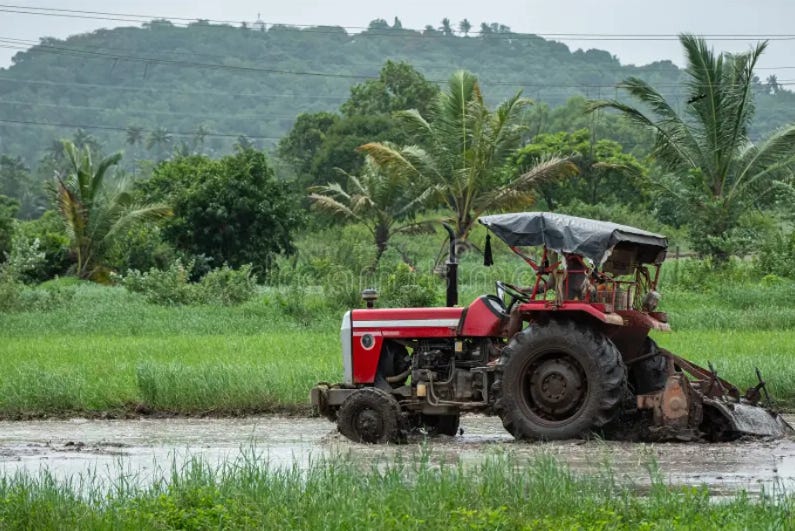
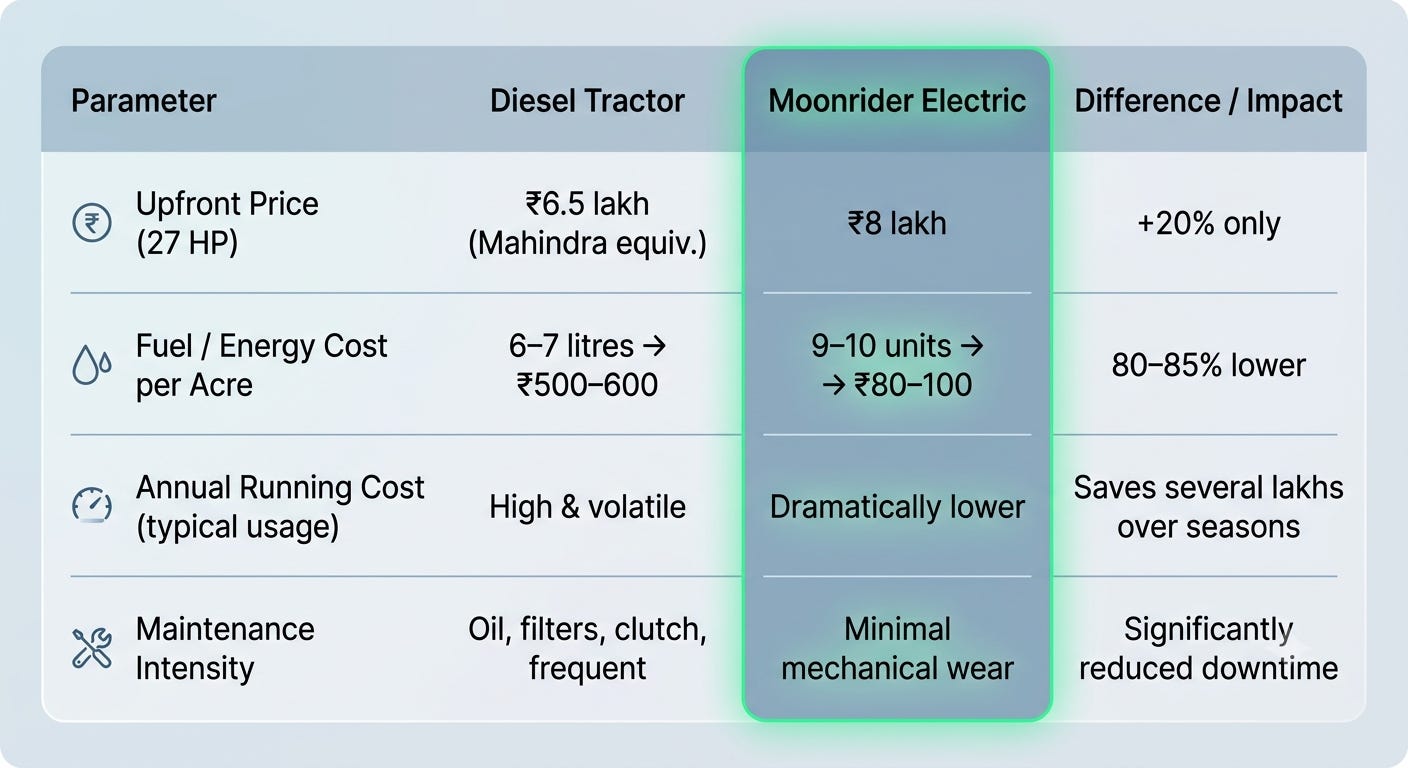
Fuel acts as the silent thief. Heavy operations like rotavating or deep ploughing burn six to seven litres of diesel per acre, costing ₹500 to ₹600 per acre in fuel alone. Multiply that across multiple passes each season, and the financial toll becomes crippling. Then come regular engine oil changes, filter swaps, clutch plate wear, and the constant fear that a peak-season breakdown will destroy both money and irreplaceable days. Labour shortages compound the pressure further. When every farmer in the region requires drivers at the same moment, daily wages spike while availability plummets.
Speak to growers across Rajasthan, Punjab, Maharashtra, or Tamil Nadu, and the same story emerges with slight variations: rising fuel bills, severe physical fatigue, labour shortages at the worst possible time, and machines that demand continuous monetary outlay.
First Light, Zero Smoke
Ramesh first heard about Moonrider through a video recommended by a farm influencer he follows online. Soon after, a neighbour operating a Custom Hiring Centre mentioned that electric tractors were entering local fleets. The core claims sounded almost unbelievable: running costs dropping from ₹500 to 600 per acre to ₹80 to 100, zero diesel fumes, whisper-quiet operation with zero engine vibration, and the ability to charge directly from the same three-phase connection already powering irrigation pumps.
He remained sceptical. Farmers have heard grand promises before. But with a massive portion of Indian farming relying on rented machinery, Custom Hiring Centres, Farmer Producer Organisations, and commercial operators were already deploying electric tractors through complete operating cycles. After speaking to fleet operators who had run them through an entire season, Ramesh decided to make the switch.
The silence on that first morning proved shocking. There was no diesel clatter, no toxic cloud of black smoke, and no harsh chatter rising through the pedals. The tractor pulled the rotavator with absolute authority, yet the sensory environment felt completely transformed. At the end of his day, Ramesh noticed something unexpected: his lower back did not ache, his throat was free of soot, and his energy remained intact. By the end of the week, he recalculated his seasonal fuel expenditure. The savings were structural, and the physical relief was immediate.
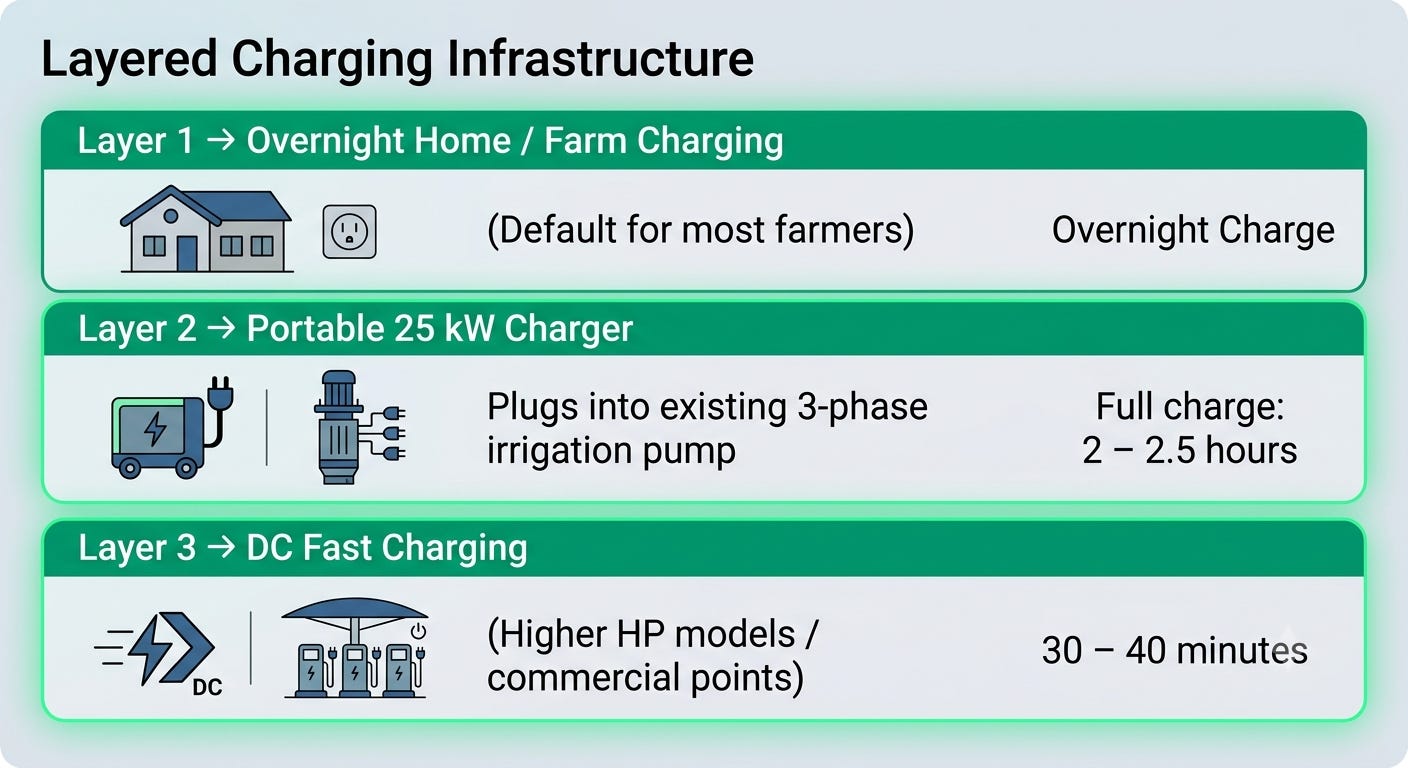
Charging integrated cleanly into farm routines. Overnight, the tractor plugged into the local grid and recharged fully. On heavier days, he deployed the portable 25 kW charger supplied with the machine, attaching it directly to the three-phase line at his pump set to achieve a full charge in two to two-and-a-half hours. The onboard software actively tracks battery health and range, sending clear alerts when it is time to plan the next charge cycle. Battery swapping was deliberately ruled out from the design stage; a heavy-duty battery pack weighs roughly 500 kilograms, making manual swapping impractical and dangerous in muddy field conditions.
Farming remains demanding labour, but the background anxiety regarding diesel prices, routine maintenance, and severe physical strain has receded. Capital that previously disappeared into the fuel tank now remains in household savings.
The Vertical Integration Play
Behind machines like the one now turning Ramesh’s soil stands Anoop Srikantaswamy, co-founder and CEO of Moonrider, alongside a very deliberate engineering philosophy.
Anoop’s career began with a deep fascination for automotive design. He worked with Toyota in India, moved to Japan with Toyota Motor Corporation, spent nine years with the Volvo Group in Sweden leading global electric vehicle programs, and later headed product development at Ola Electric. Yet the challenges that stayed with him were not the ones being solved in passenger cars or electric scooters. Cars are engineered for speed, and two-wheelers are designed for lightness. Tractors exist for a fundamentally different purpose: high torque delivered at low speeds, sustained implement operation over prolonged hours, and the physical resilience required to endure a decade of mud, dust, heat, and severe physical demands.
When Anoop and his team interviewed over a thousand farmers across India, East Africa, and Southeast Asia, direct user feedback reshaped their entire design strategy.
One major piece of feedback came from women farmers and family members. In many regions, women perform a substantial share of field operations. Still, traditional tractors feature high step-in heights, heavy mechanical steering, and rigid clutch setups that are difficult to operate while wearing sarees or traditional attire. Listening closely to both women and men, the engineering team redesigned the cabin ergonomics. They lowered the step-through access, implemented effortless power steering, smoothed out pedal response, and simplified the control layout. The result is an approachable, inclusive machine that any family member can drive comfortably for hours without requiring sheer physical force.
Solving Price Parity and National Energy Sovereignty
The hardest commercial obstacle was upfront cost. Indian farmers are remarkably well-informed business operators who calculate total cost of ownership. They will not pay double or triple the cost of a diesel tractor to adopt green technology.
To achieve price parity without depending heavily on government subsidies, Moonrider pursued deep vertical integration. Instead of purchasing off-the-shelf battery assemblies, the engineering team designed their own battery architecture, motor powertrains, and vehicle control software in-house. Addressing thermal management was paramount; standard liquid-liquid cooling systems are expensive and prone to field leakage. Moonrider patented an active immersion refrigerated battery system that slashed pack-level costs by fifty per cent, bringing pack pricing down to ₹7,000 per kWh while protecting cell health during relentless 45-degree summer operations.
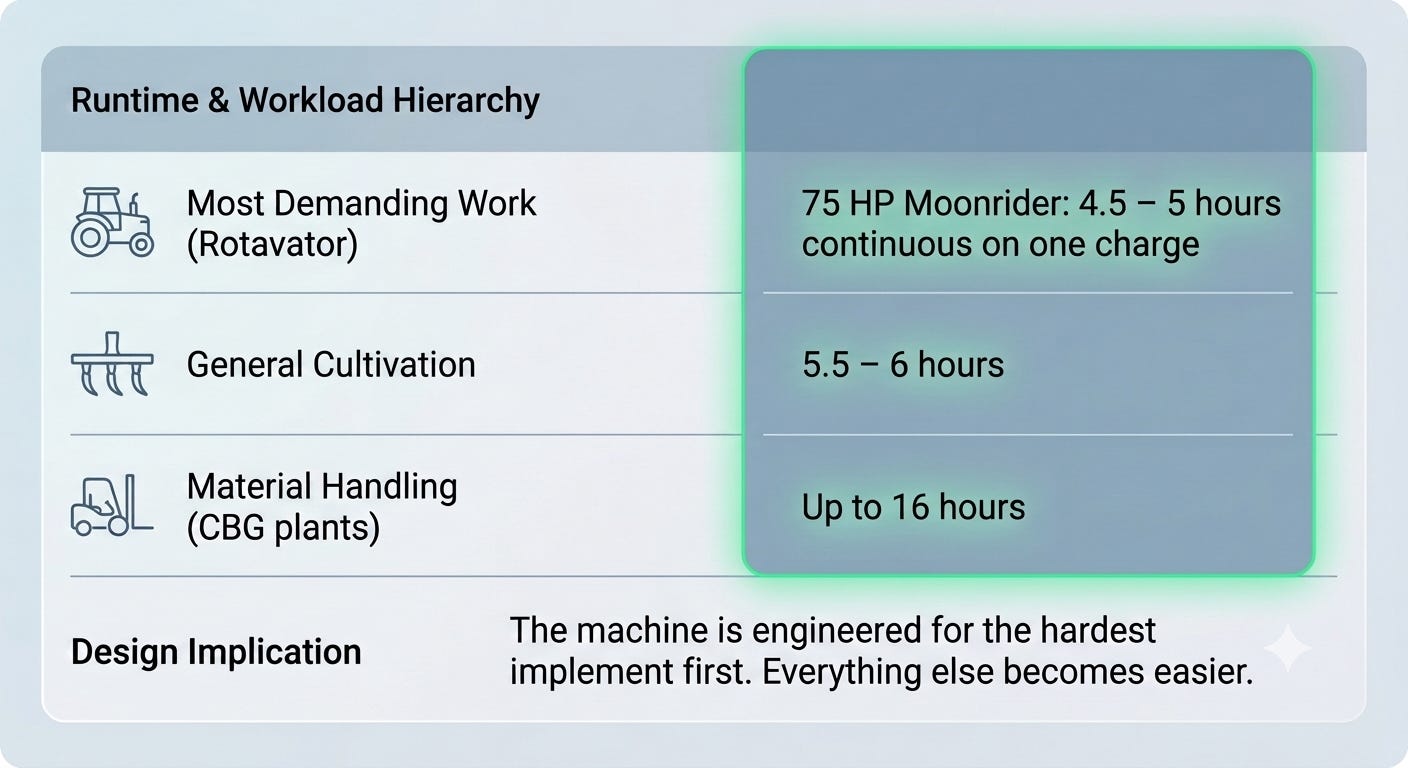
As a result, a Moonrider tractor costs roughly twenty per cent more than a comparable diesel model, a price gap that operational savings eliminate within twelve to fifteen months of active use. Running a rotavator on diesel costs ₹500 to ₹600 per acre, whereas the same work on a Moonrider machine consumes nine to ten units of electricity, costing roughly ₹80 to ₹100. Continuous field applications deliver four to five hours of heavy rotavating per charge, extending to six hours for general cultivation, and up to sixteen hours in specialized material handling operations such as Compressed Biogas (CBG) plants. In fact, nearly seventy per cent of Moonrider’s initial B2B volume comes from CBG plant ecosystems, where tractors run long daily shifts, pure unit economics outweigh brand legacy, and operational savings compound rapidly.
The broader national context reveals the true scale of this transformation. India is the largest tractor market in the world, purchasing over one million tractors every single year. At the same time, India imports roughly $185 billion worth of crude oil annually. A massive fraction of that import bill, approximately $10 billion, or nearly ₹1 lakh crore, is burned directly in agricultural diesel engines.
Beyond the Horizon: Energy Independence at the Soil Level
Transitioning Indian agriculture to electric power is not just an upgrade for individual farm budgets; it is a direct path toward Atmanirbhar Bharat (national self-reliance). Replacing imported fossil fuel with domestically generated solar and grid electricity keeps wealth within rural communities while safeguarding the country’s energy independence.
To ensure long-term reliability in remote villages, roughly seventy per cent of the mechanical components, including axles, chassis members, and brake systems, remain identical to standard diesel tractors. Local rural mechanics can service mechanical wear parts using existing tools without specialised re-training. The remaining electronic system is software-defined, enabling remote diagnostics and over-the-air updates for technical troubleshooting.
Ramesh still rises before the sun. The land still demands discipline. But the machine that once drained his seasonal income and wore down his body now protects both his earnings and his health. The margins are better, the air is clean, and the workday is quiet. That is not a corporate slogan. It is the practical reality of modern agricultural engineering, and its impact across Indian fields is only beginning.
- By Charmie Sharma,
Associate Editor, The Rocket Media