
Let me tell you a story. There once lived two friends wealth and knowledge on a small island. Both went to school together, played together and did their homework together too. The whole village gave an example of their friendship. Whenever one of them went missing at any large village gathering, the people would say, “You look incomplete without the other.” Their childhood went like this, slow and happy. But soon they turned adults and started going to college. They installed some apps in their phones which showed them fun short videos. Initially it all looked harmless, but soon whenever they had a minor disagreement, each of them would be shown videos against the other. Wealth’s feed said, “Knowledge is such a boring person, you must be in the company of interesting people. Leave her!” And Knowledge’s feed showed:

Gradually, politics of their island started becoming polarizing in nature. To gather votes politicians would often appeal to emotional sentiments of the people instead of delivering on education and health outcomes of their island. Knowledge, who felt moved witnessing these events decided to move to an island to the west of theirs which promised a better ecosystem. A few years later wealth started to miss knowledge. When he tried to contact her, he got to know that she moved to the west island a few years back due to these reasons. He was taken aback. Angered and moved by this information he decided to follow her and moved to that island too. They lived together happily thereafter.
When Knowledge meets Wealth
We met Prof. Ashutosh Sharma, former Secretary of the Department of Science and Technology and former President of the Indian National Science Academy. He offered a remarkably simple way to understand why some nations become innovation powerhouses while others remain consumers of innovation.
He said our mistake begins the moment we separate Saraswati, the goddess of knowledge, from Lakshmi, the goddess of wealth.
“Saraswati creates knowledge but it requires money to do that. Lakshmi creates money but it requires knowledge to do that.”
Then he shared an anecdote that highlights how seemingly small changes in our approach carry the power to make larger changes in society.
At most scientific conferences in India, we begin with Saraswati Vandana (prayer). Prof. Sharma deliberately includes in his events Lakshmi Vandana as well.
His explanation was simple:
“We should not condition young brains by saying only Saraswati is important.”
He continued,
“Without Lakshmi, Saraswati will do nothing. And without Saraswati, Lakshmi will do nothing.”
It is a remarkably simple idea, yet it changes how you look at an entire economy.
Universities are not meant to produce wealth. Companies are not meant to produce knowledge. But neither can prosper without the other.
Knowledge discovers new possibilities. Wealth gives those possibilities the power to change lives. Separate them, and both become weaker. Bring them together, and civilizations move forward.
That made us wonder.
If this relationship is so fundamental, why do some countries manage to keep Saraswati and Lakshmi together while others force them apart?
Perhaps the answer lies in the ecosystem and culture we have built around them.
The curious case of India
For a civilization that gave the world the idea of balancing Dharma (righteous living), Artha (wealth and prosperity), Kama (human desires and fulfilment), and Moksha (spiritual liberation), India has always understood that wealth was never the enemy of knowledge. Nor was knowledge meant to reject wealth. The four Purusharthas were designed to complement one another, not compete. In classical Indian thought, Artha is a legitimate pursuit, provided it is guided by Dharma.
Somewhere along the way, however, we forgot that balance.
Over time, wealth and knowledge drifted into separate worlds. Universities became places where commercial ambition was often viewed with suspicion. Below is a graph displaying the contribution of Indian Univeristy Research Institutions to total patents granted to Indian inventors over a period of five years (2016-2021).
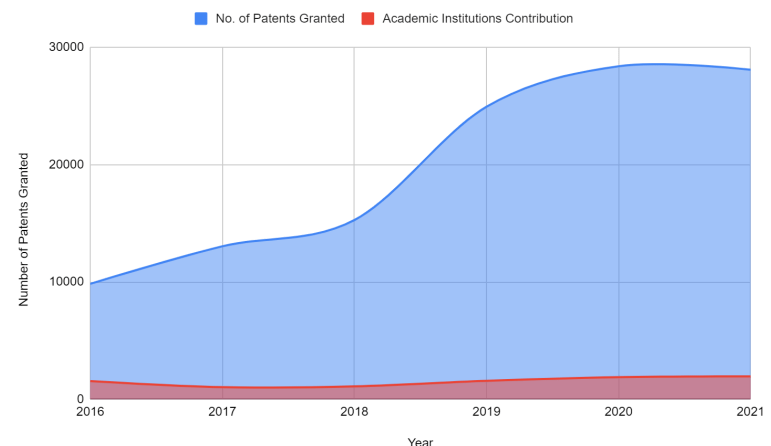
Source: WIPO Statistics for India
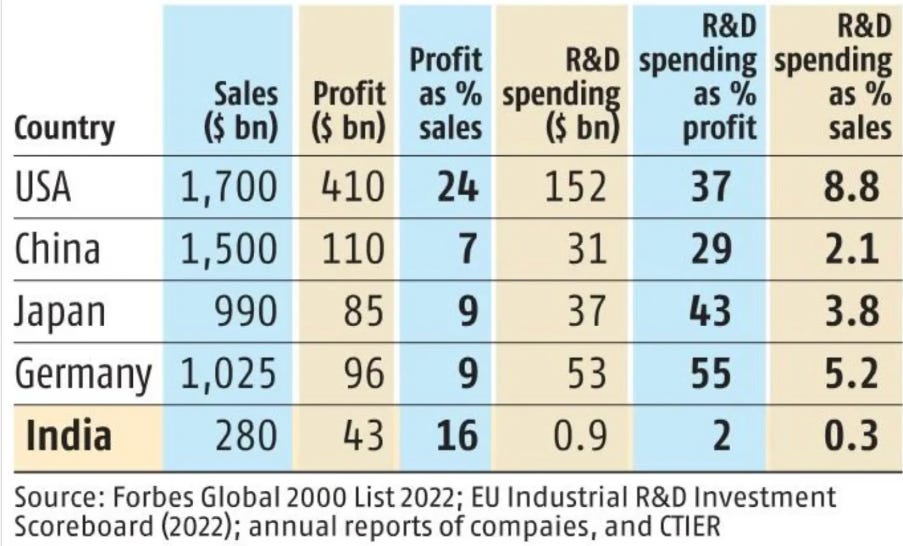
Businesses, meanwhile, learned to value execution more than original research which is reflected as one of the lowest R&D investment as a percentage of profits. One produced papers. The other produced profits. Very few produced breakthroughs.
But building new knowledge is fundamentally an act of uncertainty.
Research is a bet on an answer that does not yet exist. Deep technology is a bet that may take a decade to pay off. Scientific discovery demands the willingness to fail repeatedly before succeeding once. Societies that transform science into industry are rarely those with the smartest people alone. They are the ones willing to finance uncertainty, reward long-term thinking and celebrate calculated risk.
India has never lacked brilliant minds.
What it has often lacked is an ecosystem where those minds and long-term capital grow together. Below is an infographic which puts the overall picture in a global perspective for you. It is the average answer to the survey question: In your country, to what extent do businesses and universities collaborate on research and development (R&D)? [1 = not at all; 7 = to a great extent].
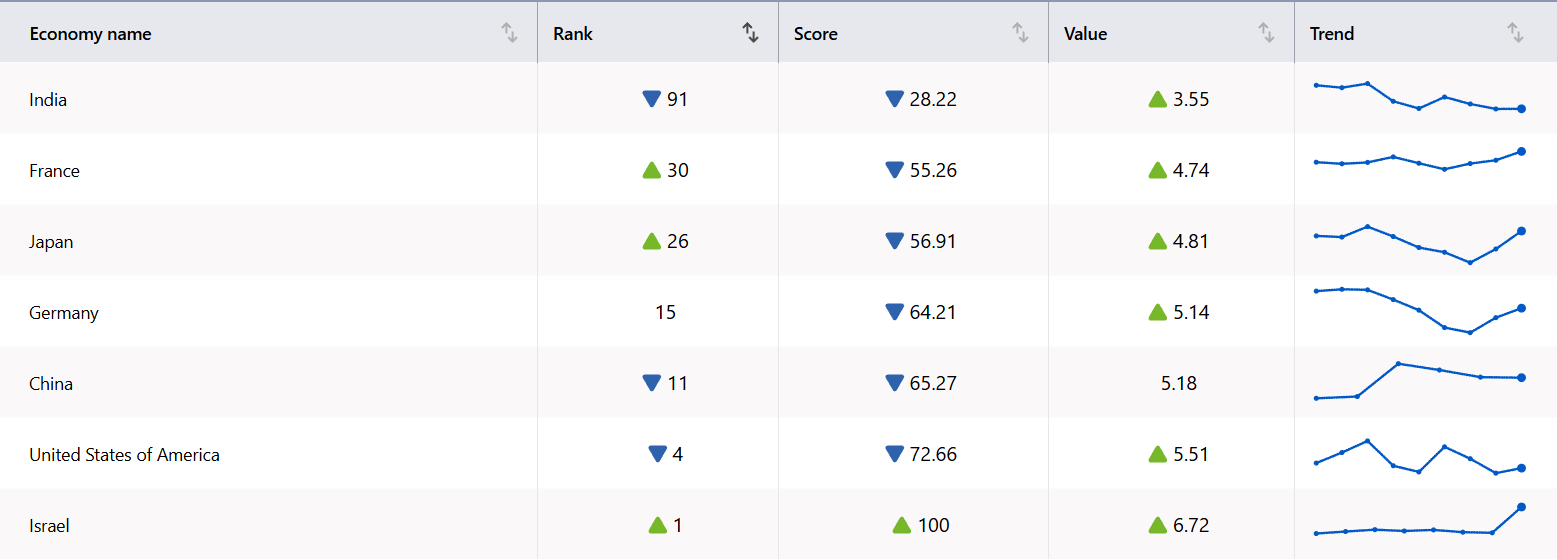
Source: World Economic Forum, Executive Opinion Survey (EOS); Years: 2016-2024
That is perhaps why a recent development in India’s space programme deserves far more attention than it has received.
Over the past few months, more than 100 experienced ISRO scientists have resigned or taken voluntary retirement, prompting the Department of Space to tighten exit rules for scientists working on flagship missions like Gaganyaan. Many reports point to a combination of better pay, greater recognition and new opportunities in India’s rapidly expanding private space sector.
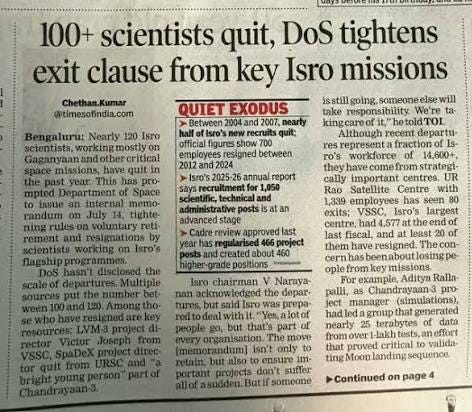
At first glance, this looks like a brain drain.
It isn’t.
It is a migration of Saraswati towards Lakshmi.
Knowledge is simply moving closer to the ecosystem where it believes it can create greater impact.
In one sense, this is good news. It signals that India’s private deep-tech ecosystem is finally becoming strong enough to attract world-class scientific talent. Founders of companies like Skyroot themselves came from ISRO, and the opening of India’s space sector has created entirely new pathways for scientists to become entrepreneurs.
But it also raises a larger question.
If our brightest scientists increasingly feel that their best opportunity lies outside our research institutions, are we strengthening the bridge between knowledge and wealth or simply shifting knowledge from one island to another?
That question matters far beyond ISRO. It goes to the heart of whether India can build an economy where Saraswati and Lakshmi walk together again, instead of constantly searching for each other.