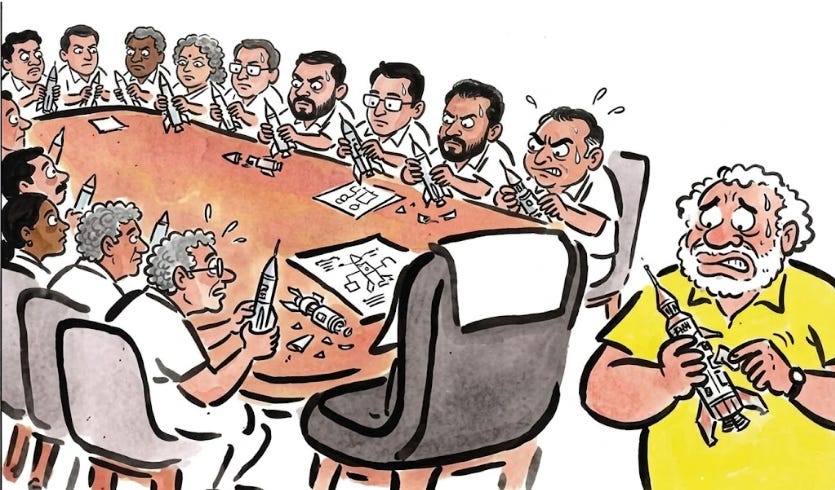
The air was tense. People were looking at cluttered sheets of paper for answers, some were googling and using claude but none was able to find one. AC was working at 22 degree celsius, yet you could see people sweating, because their leader wanted an answer as soon as possible.
And then the titan rose from his seat, adjusted his collar and said, “There is an easy and effective way in which we can reduce the costs of our rocket launches!” Everyone looked at him with hope. The leader said, “What?” He replied, “Why don’t we use 25% ethanol blending in rocket fuel? That way we can drastically reduce costs as those currently being used are already too costly to produce.”
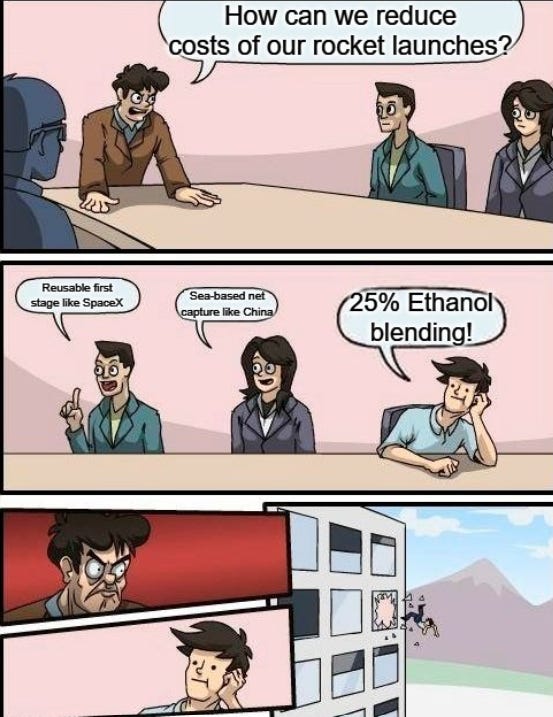
Reports suggest that the leader has been waking up half an hour early from the very next day to do some more yoga postures and maintain his calm. But the central problem still hangs naked, “How to reduce the cost of rocket launches in India?”
Cost Breakdown
Before asking how India can reduce launch costs, we first need to know where the money actually goes.
A modern orbital rocket is one of the most expensive machines ever built because it burns its engineering within a few minutes of its launch.
Here’s what a typical expendable launch vehicle looks like.
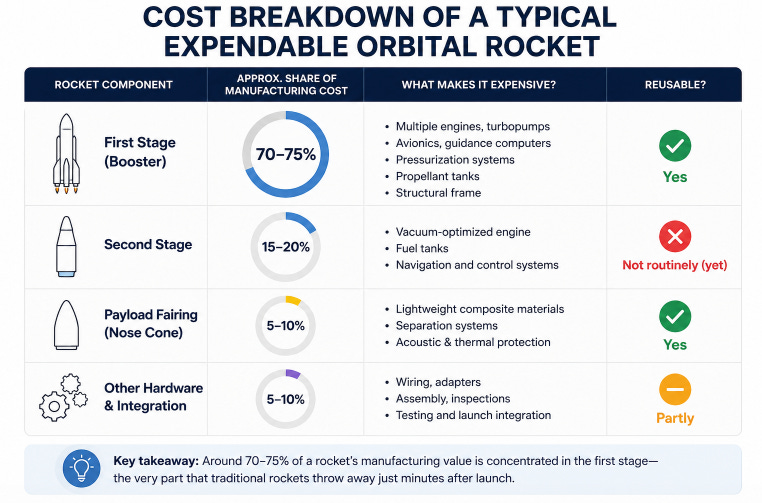
The first stage is where almost all the money sits.
It houses the rocket’s most valuable hardware: multiple engines, turbopumps spinning at tens of thousands of RPM, flight computers, navigation systems, hydraulic actuators, pressurisation systems, valves, wiring and massive propellant tanks. Aerospace studies estimate that this single stage accounts for roughly three-fourths of the vehicle’s manufacturing cost.
The second stage is much simpler. It only has to operate once in the vacuum of space and doesn’t need landing systems or the structural strength required for launch. As a result, it contributes only about 15–20% of manufacturing costs.
Even the payload fairing, the nose cone protecting the satellite, is surprisingly expensive. Made from lightweight composite materials and designed to survive supersonic flight before separating flawlessly, it can account for another 5–10% of the rocket’s cost. SpaceX now routinely recovers and reuses these as well.
And the fuel?
Ironically, it is almost irrelevant.
For Falcon 9, studies estimate that the combined cost of rocket-grade kerosene and liquid oxygen is less than 1% of the launch price, roughly 0.3% in some analyses.
Which brings us to absurdity.
After barely 150 seconds of flight, the first stage completes its job...
...and falls into the ocean.
That means every launch throws away around 70% of the rocket’s manufacturing value after just two and a half minutes.
SpaceX looked at this and asked a simple question:
What if we stopped throwing away the most expensive part?
That single question changed the economics of space forever.
What did America, and recently China, do?
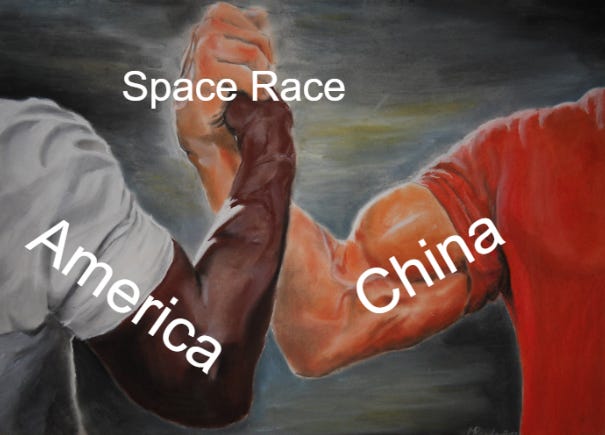
America and China are currently leading the space race with substantial and timely contributions from India. But who started the idea of reusable rockets? Let’s go back in time!
The Americans not only invented reusable rockets.
They made them economically useful.
For decades, engineers knew that recovering rockets was theoretically possible. The problem was that refurbishing them often cost almost as much as building new ones. SpaceX changed the equation by designing the Falcon 9 so that its first stage could autonomously return to Earth, land vertically, undergo minimal refurbishment and fly again. Today, individual Falcon 9 boosters have flown more than 30 missions each, and the company has completed hundreds of successful booster recoveries, making reuse a routine part of launch operations rather than an engineering spectacle.
But Elon Musk, as always, wasn’t satisfied.
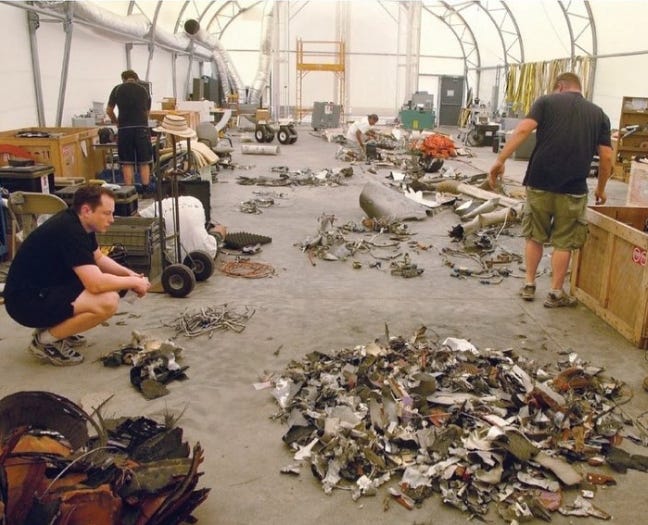
(The picture might break your reading flow, but telling the story without this picture would be cheating)
Landing a booster still meant adding heavy landing legs, transporting it back to the launch site and spending days preparing it for another flight. So with Starship, SpaceX went one step further. Instead of landing on legs, the returning booster is caught mid-air by giant mechanical arms, nicknamed Mechazilla. No landing legs. Less weight. Faster inspections. Quicker turnaround. The goal is simple: make rockets behave less like disposable machines and more like commercial aircraft.
And now, China has entered the race.
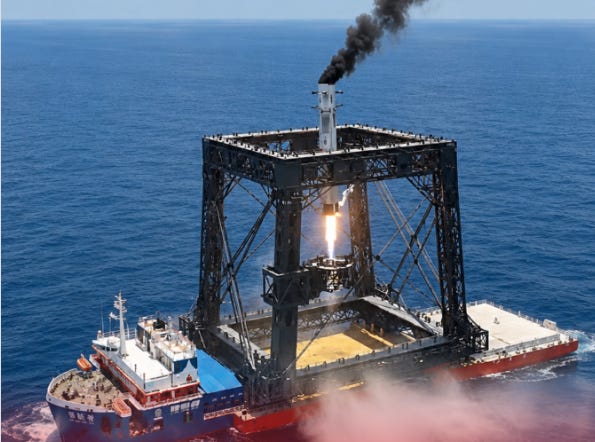
Last week, China successfully recovered the first stage of its Long March-10B using a sea-based net capture system, a completely different approach from SpaceX’s chopstick arms. By replacing landing legs with a lightweight capture mechanism, Chinese engineers hope to save mass, carry heavier payloads and reduce refurbishment time. More importantly, this wasn’t a one-off technology demonstration. It is part of China’s larger plan to support its satellite megaconstellations, lunar ambitions and a future of high-frequency launches. Another reusable Long March mission is already planned later this year.
Different engineering.
Same idea: stop throwing away the most expensive part of the rocket.
But why is catching so important?
Reducing launch costs is just the beginning.
The real prize is speed. Every recovered booster is one less rocket that must be built from scratch. This allows a country to launch satellites far more frequently, replace failed ones within days rather than months, and respond swiftly in emergencies or conflicts. In today’s space race, launch cadence has become just as critical as raw launch capability.
Then there is scale. The coming decade will be defined by the ability to launch thousands of satellites in space. Megaconstellations like Starlink, China’s Guowang, or future Earth observation networks only become truly viable when rockets can fly repeatedly instead of being rebuilt after every mission.
There is also a powerful strategic dimension. Modern militaries rely heavily on satellites for navigation, surveillance, communications, and missile warning. In a conflict, the side that can replenish disabled orbital assets the fastest holds a major advantage. Reusable rockets transform space access from a peacetime luxury into a genuine wartime capability.
Finally, there is industrial capability. Building a rocket is hard.
But, building one that can survive launch, fly at hypersonic speeds, return through the atmosphere, land with metre-level precision and fly again is an entirely different game. It requires mastery over advanced propulsion, autonomous guidance, materials science, precision manufacturing and high-reliability software. In many ways, catching a rocket is less a space milestone than a demonstration of a nation’s engineering maturity.
And there’s another reason this race matters: AI. The world’s biggest technology companies are already exploring space-based data centres powered by continuous solar energy, where satellites process data in orbit instead of sending massive volumes back to Earth. While the concept is still experimental, agencies like ESA and several private firms see it as a long-term solution to the exploding demand for AI compute. But none of it is feasible without one prerequisite: cheap, high-frequency, reusable launches. If AI’s future extends into orbit, the countries that master rocket reusability today will be the ones building tomorrow’s cloud infrastructure.
Which is why we see the race to catch the future of space access via catching the rockets!

Where are India’s fielders?
If this were cricket, India has finally walked onto the field.
The problem is that America is already fielding, and China has just started taking catches.
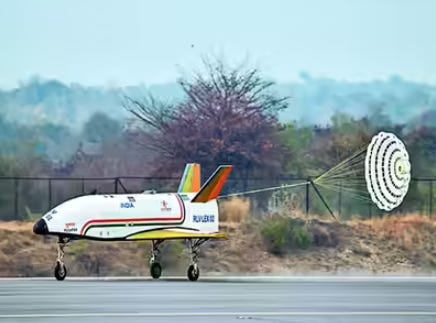
India’s reusable rocket journey began in 2016, when ISRO launched the Reusable Launch Vehicle-Technology Demonstrator (RLV-TD), a winged prototype that looked more like a miniature space shuttle than a Falcon 9. The goal wasn’t to recover boosters vertically, but to master one of the hardest parts of reusability: surviving re-entry and landing autonomously.
Seven years later, in 2023, ISRO crossed another milestone. Nicknamed Pushpak, the vehicle was carried to 4.5 km by an Indian Air Force Chinook helicopter, released mid-air and landed itself on a runway without a pilot. A second successful landing experiment followed in 2024, proving that India could repeatedly execute autonomous landings.
But here’s the catch.
Pushpak isn’t the rocket that will carry India’s satellites.
It is a flying laboratory.
The real game is NGLV (Next Generation Launch Vehicle), internally known as Project Soorya. Unlike today’s PSLV and LVM3, NGLV is being designed from day one with a reusable first stage, landing legs, advanced guidance systems and recovery capability. It is expected to become the workhorse for India’s future space station, lunar missions and heavy commercial launches.
And now, the private sector is also beginning to pad up.
Skyroot Aerospace has spoken about incorporating reusable technologies into its future Vikram launch vehicles, while Agnikul Cosmos is developing highly modular rockets whose rapid manufacturing philosophy aligns naturally with future reusability. Newer startups such as EtherealX have gone even further, placing fully reusable heavy-lift rockets at the centre of their long-term vision and Astrobase is targeting reusability of rockets by 2030 for India
So when will India actually catch its rockets?
If India’s current roadmap stays on track, the first demonstrations of reusable booster technology are likely to happen toward the end of this decade, with operational reusable launches expected in the early 2030s alongside the NGLV programme.
One who innovates always wins!
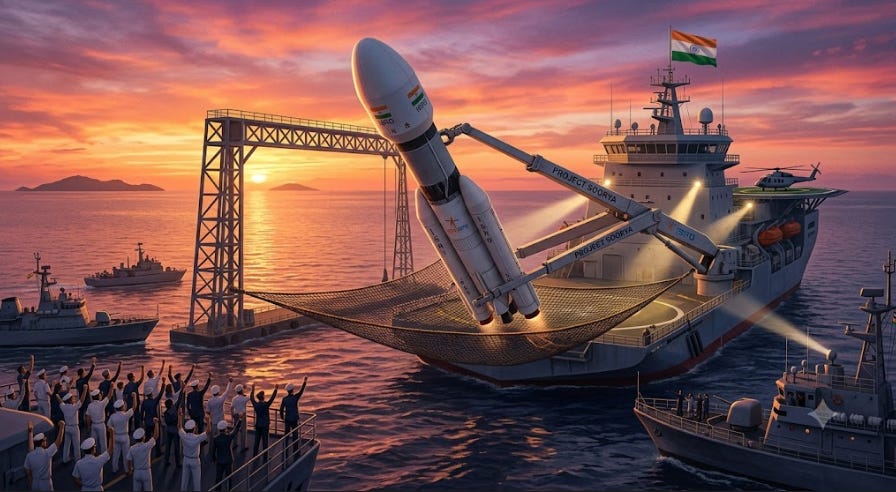
This roadmap requires steady nerves, but betting against India has rarely been a winning move. Our journey, stretching from satellite parts on cycle carriers to the high-stakes precision of the lunar south pole, is a record of defying the odds. We find our way. Between the silent corridors of ISRO and the hungry ambition of deep-tech disruptors, a familiar spirit is currently waking up. One day, the data will sync, the engines will throttle, and India will finally secure that historic catch over the waves.
When that moment lands, it will be more than a technical feat; it will be a profound national dawn where we finally stand as equals among the elite orbital powers.
But parity cannot be the final destination. The space race moves with too much momentum for us to simply follow existing trails. The real hurdle in this era is innovating with such radical speed that we start defining the pace. We need to forge architectures so bold that the world turns its gaze to our sky in wonder. The innings has begun, the stands are full, and it is time for India to stop playing the game and start rewriting the rules.